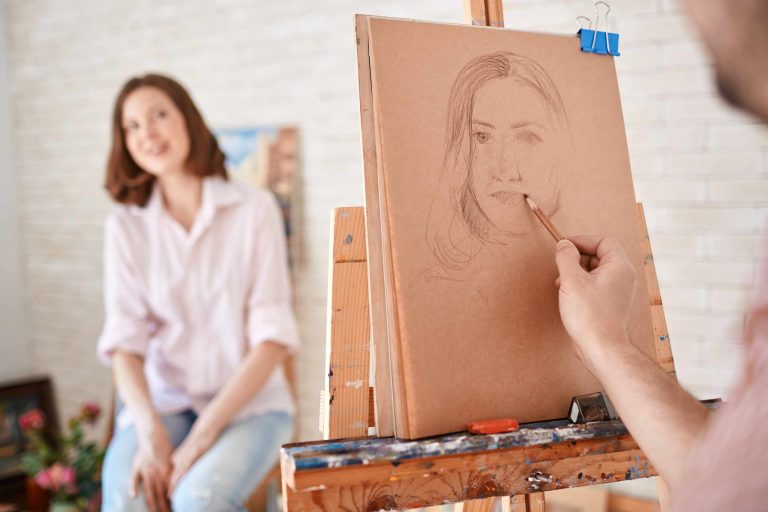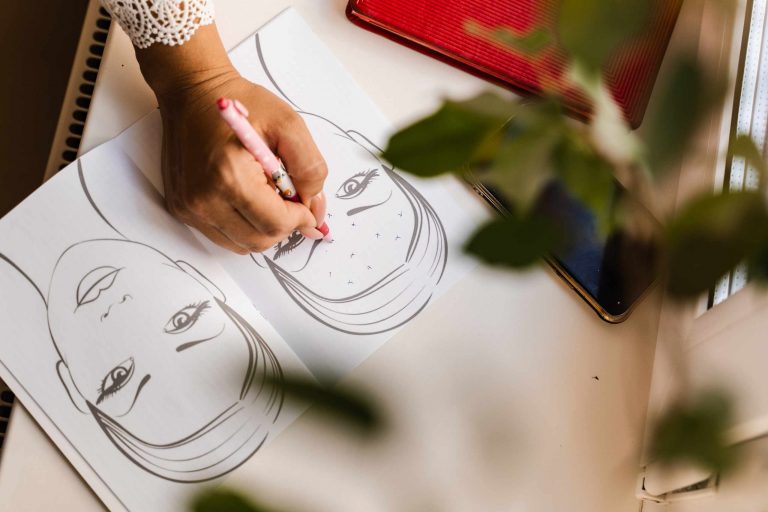

Before drawing the nose and mouth, check the reference and lightly place three landmarks: the brow, the bottom of the nose, and the chin. Next, compare the measurements between those points. Don’t think about nostrils, lips, or shading just yet. By placing these divisions, you’ve given the nose and mouth a place to go on the face instead of having to place them from memory.
This technique is very helpful if the subject’s face is turned to the side. Trace the center line from the top of the forehead, down through the nose, and then to the chin. The nose shouldn’t be placed directly in the center of the visible face, but instead follow the center line. Notice how far the nose extends from the center line, and how much of each nostril is visible. Even a slight turn will alter these proportions.
Once the nose feels correctly placed, you can use it to help judge the mouth. Notice the distance between the bottom of the nose and the mouth, and compare it to the distance between the mouth and the chin. Note the corners of the mouth in relation to nearby features, but don’t feel compelled to replicate those relationships, as they aren’t always consistent. Remember that the reference takes priority, since the size of the lips, chin length, facial expression, and head angle vary from person to person.
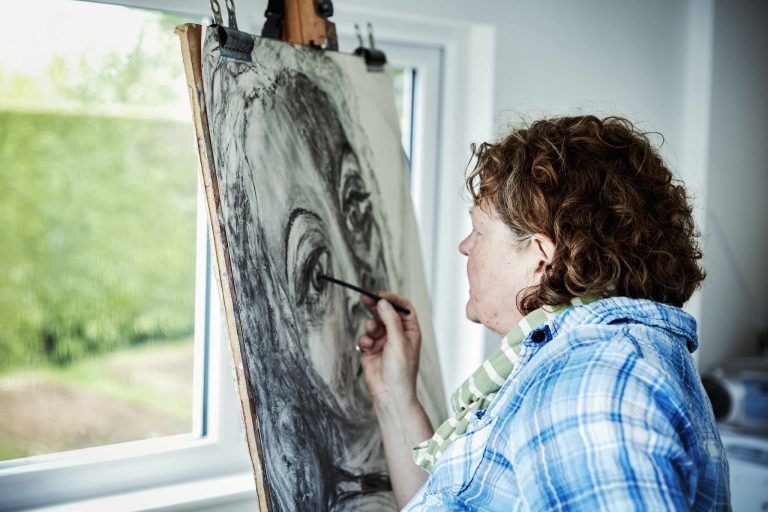
Problems can arise if you draw the nose and mouth as clichéd representations. You might draw a nose as a triangle with two holes for nostrils, or a mouth as a thin, curved line between two dark lips. Each of these features might look good independently, but won’t fit with the rest of the portrait. Instead, look for areas of value change. The underside of the nose may create a darker value than the rest of the nose, the top lip may sit in a shadow relative to the bottom lip, or the corners of the mouth may blend softly into the rest of the face. These shifts in value can define the form without putting a hard outline around every feature.
To practice this method, try to draw the bottom half of a portrait from a reference photo. First, lightly mark the center line, bottom of the nose, mouth line, chin, and jaw line. Keep your lines light and focus more on comparing distances than drawing details. Then, add the nose as a few simple planes and shadow shapes. Next, suggest the lips by drawing the overall shape of the mouth and indicating where shadows and highlights fall. If something feels off, erase the entire feature and reposition it, instead of pulling one edge further out to make up for it.
Before committing any darker marks to the paper, block out the finer details and look only at the spacing. Is the nose positioned correctly between the brow and the chin? Is there enough space below the mouth for the chin to exist? Does the center line still correspond to the direction of the head? Addressing these issues while the drawing is still light will do more to improve your likeness than adding another set of nostrils, lip wrinkles, or shading marks.